Asset Tracking: The Complete Guide to GPS, IoT and Smart Asset Tracking for Businesses in 2026
August 19, 2026
How businesses use GPS trackers, Bluetooth beacons, IoT sensors and solar-powered technology to track trailers, ISO tankers, equipment, vehicles and personnel
For many businesses, knowing where their vehicles are is only part of the problem.
The trailer attached to the truck may be somewhere else.
An ISO tanker may have been detached from its prime mover.
A construction asset may be sitting at a remote site for weeks without being used.
A solar-powered asset may be deployed across a large geographical area with no convenient power source.
Personnel may be working in locations where traditional vehicle tracking provides no visibility.
This is where asset tracking becomes increasingly important.
Modern asset tracking has evolved beyond simply installing a GPS tracker on an asset. Businesses can now combine GPS, 4G connectivity, Bluetooth Low Energy (BLE), IoT sensors, geofencing, solar power, accelerometers and workforce tracking to create a more complete picture of where assets are, how they are being used and how they move between locations.
For fleet operators, logistics companies, construction businesses, utilities and organisations managing distributed assets, the right asset tracking solution can improve asset visibility, utilisation, security, operational planning and cost control.
What Is Asset Tracking?
Asset tracking is the use of technology to monitor the location, movement, status and utilisation of physical assets.
An asset may include:
• Trailers
• ISO tankers
• Containers
• Prime movers
• Construction equipment
• Heavy machinery
• Solar equipment
• Mobile assets
• High-value equipment
• Tools
• Personnel
• Other movable or distributed assets
Depending on the business requirement, asset tracking can use different technologies.
These include:
• GPS/GNSS tracking
• 4G/LTE connectivity
• Bluetooth Low Energy (BLE) beacons
• Wi-Fi scanning
• IoT sensors
• Accelerometers
• Geofencing
• Solar-powered trackers
• Battery-powered trackers
• Personnel tracking devices
The important point is that there is no single asset-tracking technology that is ideal for every asset.
A trailer travelling across Singapore and Malaysia may require a different solution from a construction machine operating at a remote site.
An ISO tanker that frequently attaches and detaches from different prime movers may require a different architecture again.
This is why asset tracking should begin with the asset and business process, rather than the tracker itself.
Why Is Asset Tracking Important?
Businesses often invest heavily in physical assets but have limited visibility into where those assets are and how efficiently they are being used.
Without asset tracking, organisations may rely on:
• Manual check-ins
• Telephone calls
• Spreadsheets
• Driver reports
• Paper records
• Periodic physical inspections
These methods can work at a small scale.
However, as the number of assets increases, manual tracking becomes increasingly difficult.
A fleet operator managing hundreds of trailers may not know immediately:
Which trailer is at which depot?
A logistics operator may not know:
Which ISO tanker is currently attached to which prime mover?
A construction company may ask:
Where is our equipment, and has it actually been used recently?
An operations manager may need to know:
Which assets have remained stationary for too long?
Asset tracking provides a digital layer of visibility.
Instead of asking where an asset was last reported, businesses can potentially see its current or most recent known status through a central platform.
Asset Tracking vs Vehicle Tracking: What Is the Difference?
This distinction is important.
Vehicle Tracking
Vehicle tracking generally focuses on powered vehicles such as:
• Cars
• Vans
• Trucks
• Prime movers
• Buses
• Service vehicles
The tracker is normally powered by the vehicle and can therefore communicate location and other vehicle-related information.
Asset Tracking
Asset tracking focuses on equipment that may:
• Have no engine
• Have no permanent power supply
• Move independently of a vehicle
• Be detached from a vehicle
• Remain stationary for long periods
• Operate in remote locations
Examples include:
• Trailers
• ISO tankers
• Containers
• Construction equipment
• Mobile generators
• Solar assets
• Other non-powered assets
This creates a fundamental technical challenge:
How do you track something that does not have its own permanent power source or network connection?
Different IoT architectures can solve this problem in different ways.
The Different Types of Asset Tracking Technology
1. GPS Asset Tracking
GPS/GNSS is one of the most direct methods of asset tracking.
A GPS tracker installed on an asset can determine its geographical position and transmit information to a cloud platform using cellular connectivity.
A typical architecture looks like:
Asset → GPS/GNSS → 4G/LTE → Cloud Platform → Dashboard
Businesses can then view asset locations and configure alerts.
Typical applications include:
• Trailer tracking
• Container tracking
• Equipment tracking
• Construction asset tracking
• Mobile machinery tracking
A solar-powered GPS tracker can be particularly useful for assets that do not have a reliable electrical power source.
2. Solar-Powered Asset Tracking
One of the challenges with tracking trailers, containers and other non-powered assets is battery life.
Installing a tracker with a small internal battery may work for a limited period, but frequent battery replacement creates an operational burden.
Solar-powered tracking provides another option.
V3’s 4G Solar Asset Tracker is designed for real-time asset visibility and includes 4G LTE connectivity, real-time GPS tracking, solar charging, geofencing, alert notifications and IP67 water and dust resistance.
The tracker also supports different battery configurations, including 3,200 mAh, 12,800 mAh and 22,400 mAh options, with solar charging support.
This makes solar-powered tracking particularly relevant for assets that spend significant amounts of time outdoors.
Suitable Applications
Solar asset tracking can be considered for:
• Trailers
• Containers
• Construction equipment
• Transportation assets
• Remote assets
• Mobile equipment
• Outdoor infrastructure
The underlying objective is simple:
Reduce dependence on manual charging while maintaining asset visibility.
3. Bluetooth Beacon Asset Tracking
Not every asset needs its own GPS tracker.
In some applications, the key question is not:
“Where is the trailer?”
but:
“Which prime mover is this trailer currently attached to?”
This is where Bluetooth Low Energy (BLE) beacons can provide an efficient IoT approach.
A small Bluetooth beacon can be attached to an asset such as:
• ISO tanker
• Trailer
• Container
• Equipment
A Bluetooth-enabled tracker or gateway installed on the prime mover can detect the beacon.
The system can then determine whether the asset is:
Attached → Detected by prime mover
or:
Detached → No longer detected by prime mover
This creates an important relationship between two physical assets.
How Bluetooth Attachment and Detachment Tracking Works
Consider a logistics company operating 100 prime movers and 300 trailers.
Each trailer receives a BLE beacon.
Each prime mover has a compatible tracking gateway.
When Trailer A is connected to Prime Mover 23:
Trailer A BLE beacon → Prime Mover 23 detects beacon → Platform records attachment
When the trailer is detached:
Beacon no longer detected → System records detachment
The fleet manager can therefore see not only the prime mover’s location but also the asset relationship.
This can provide valuable information such as:
• Which trailer is attached to which truck?
• When was the trailer attached?
• When was it detached?
• How long was it attached?
• Which prime mover last carried the trailer?
• Where did the attachment occur?
This is particularly useful for businesses managing large numbers of trailers and tankers.
Why BLE Can Be Better Than GPS for Some Assets
A common misconception is that every asset should have its own GPS tracker.
That is not necessarily the most efficient architecture.
Imagine a company with:
500 prime movers + 1,500 trailers
Installing a full GPS tracker with cellular connectivity and independent power on every trailer may increase hardware, connectivity and maintenance requirements.
An alternative architecture could be:
GPS/4G tracker on prime mover + BLE beacon on trailer
The prime mover provides:
• GPS location
• Cellular connectivity
• Gateway functionality
The trailer provides:
• Unique BLE identity
The platform can then associate the two.
This creates a potentially more cost-effective architecture for asset association and attachment/detachment visibility.
4. GPS + BLE: A More Complete Asset Tracking Architecture
For sophisticated fleet operations, GPS and BLE can work together.
For example:
Prime Mover
→ GPS tracking
→ 4G connectivity
→ BLE gateway
Trailer / ISO Tanker
→ BLE beacon
Cloud Platform
→ Location
→ Asset identity
→ Attachment status
→ Detachment status
→ Historical movements
→ Alerts
→ Reports
This allows the fleet manager to understand both:
Where is the vehicle?
and:
Which asset is it carrying?
That distinction can be extremely valuable in transportation and logistics.
Asset Tracking for ISO Tankers
ISO tankers can present a particularly interesting tracking challenge.
The tanker itself may move between:
• Prime movers
• Depots
• Ports
• Customer sites
• Warehouses
• Industrial facilities
The tanker therefore needs its own identity independent of the truck.
A BLE-enabled asset tracking architecture can associate the ISO tanker with the prime mover while GPS tracking provides the geographical location of the vehicle.
This can create an operational record such as:
Event Information
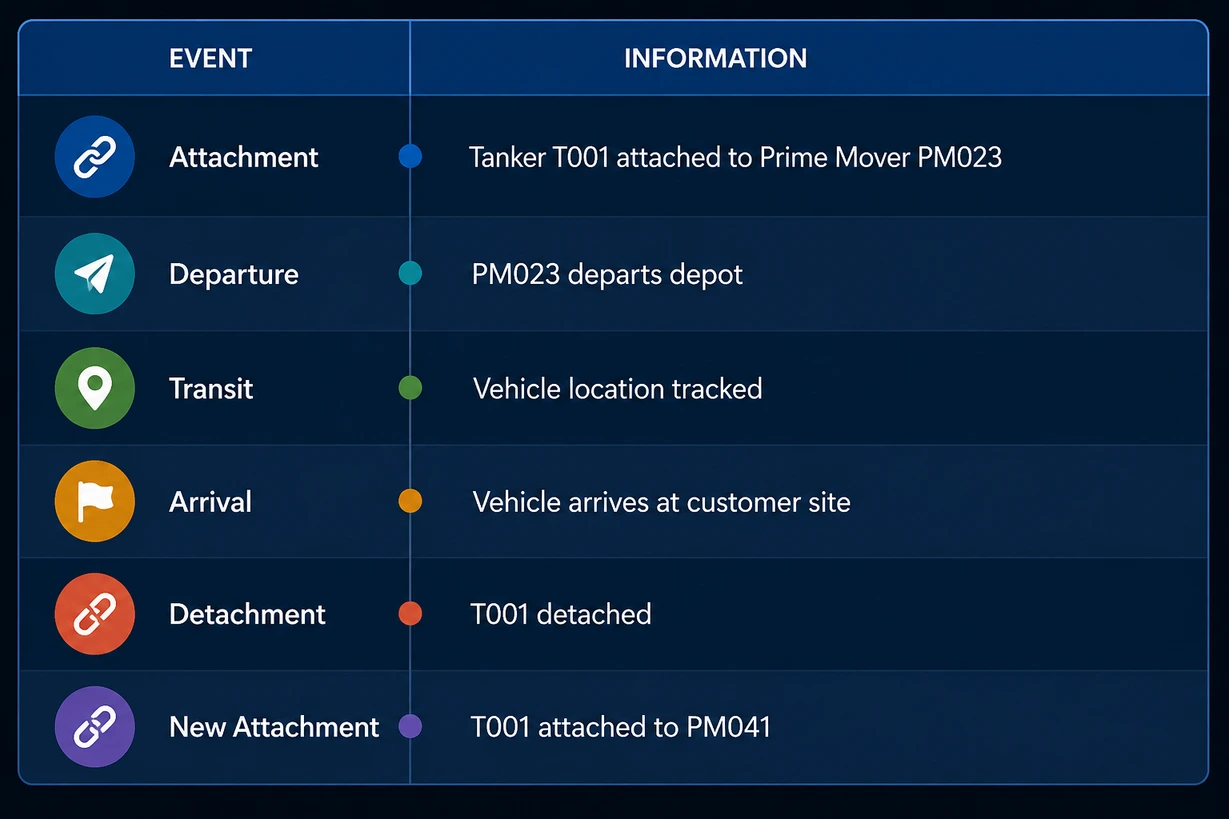
Instead of treating every movement as a vehicle event, businesses can begin tracking the asset lifecycle.
Asset Tracking for Trailers
Trailer fleets are often significantly larger than prime-mover fleets.
Trailers may spend considerable periods:
• Waiting at depots
• At customer sites
• At ports
• In maintenance
• In loading areas
• Parked in yards
Without tracking, these assets can become difficult to manage.
Asset tracking can help answer:
• Where is each trailer?
• Which trailers are available?
• Which trailers are currently attached?
• Which trailers have been stationary?
• Which trailers have entered or left a designated area?
• Which trailers have not moved for an extended period?
This supports better fleet utilisation.
Asset Tracking for Construction Equipment
Construction companies often operate equipment across multiple sites.
Examples include:
• Machinery
• Generators
• Compressors
• Mobile equipment
• Site assets
• Temporary infrastructure
Because equipment may be moved between sites, asset tracking can provide a centralised view of where assets are deployed.
Geofencing can also be used to define:
• Construction sites
• Depots
• Restricted zones
• Storage yards
When an asset enters or exits a defined geographical area, the system can generate an alert.
Solar Asset Tracking
The emergence of distributed solar infrastructure creates another application for asset tracking.
Solar-related equipment may be deployed across:
• Construction sites
• Remote locations
• Utility sites
• Temporary facilities
• Industrial environments
The challenge is that these assets may be geographically dispersed and may not have a convenient permanent power supply.
A solar-powered GPS tracker can provide location visibility while using solar energy to extend operational life.
V3’s solar asset tracker is designed for outdoor and harsh environments, with IP67 water and dust resistance, solar charging and 4G connectivity.
Its stated applications include fleet management, trailer and container logistics, construction assets and transportation.
Personnel Tracking: Extending Asset Visibility to People
Asset tracking does not necessarily stop with physical equipment.
In certain industries, businesses also need visibility of personnel working across large, remote or high-risk environments.
Personnel tracking can be used to understand:
• Where workers are located
• Whether workers are within designated areas
• Whether personnel have entered or exited a site
• Whether assistance may be required
• Whether manpower is positioned appropriately
Potential applications include:
• Construction
• Facilities management
• Utilities
• Security
• Emergency response
• Remote-site operations
The technology used may include dedicated personnel trackers, BLE devices, GPS-enabled devices or other IoT technologies depending on the operating environment.
This creates a broader concept:
People + Vehicles + Assets = Connected Operations
What Is Geofencing in Asset Tracking?
Geofencing creates a virtual geographical boundary around a physical location.
Examples include:
• Depot
• Warehouse
• Construction site
• Customer location
• Port
• Restricted area
When a tracked asset enters or exits the area, the platform can generate an event.
For example:
Trailer enters depot → arrival event
Trailer leaves depot → departure event
Construction asset leaves approved site → alert
Personnel enters restricted zone → notification
V3’s solar asset tracker supports round or polygonal geofencing and geofence alerts.
Geofencing therefore turns location information into an operational workflow.
Beyond Location: Understanding Asset Movement
Modern asset tracking does not have to provide only latitude and longitude.
Sensors can provide information about how an asset is behaving.
The V3 solar tracker includes a 3-axis accelerometer capable of helping determine whether a tracker is vibrating, moving or stationary.
It also supports events such as:
• Impact detection
• Harsh cornering
• Harsh acceleration
• Harsh braking
• Speeding alerts
• Installation/drop alerts
• Heartbeat reporting
• Battery alerts
This allows businesses to move beyond:
“Where is my asset?”
towards:
“What is happening to my asset?”
Asset Security and Theft Prevention
Asset theft and unauthorised movement can create significant financial losses.
Tracking technology can provide another layer of security by identifying unusual movement.
For example:
Asset stationary at approved depot → unexpected movement detected → GPS location transmitted → alert generated
Geofencing can also help identify when an asset leaves an approved area.
While no tracking system can guarantee prevention of theft, real-time visibility and alerts can reduce the time between an unauthorised movement occurring and the business becoming aware of it.
V3 identifies reducing asset loss and theft, improving asset utilisation and increasing security and control among the business benefits of its solar asset tracking solution.
Asset Utilisation: The Often-Overlooked Benefit
Knowing where an asset is provides visibility.
Knowing whether it is being used provides business intelligence.
Consider a company with 200 trailers.
If 40 trailers have been stationary for extended periods, the business may have an opportunity to:
• Reallocate assets
• Reduce unnecessary purchases
• Improve fleet utilisation
• Optimise depot capacity
• Review customer allocation
• Identify underutilised equipment
Asset tracking can therefore contribute to better capital utilisation.
The goal is not simply to track more assets.
The goal is to use existing assets more effectively.
Asset Tracking and Fleet Management: The Complete Picture
Asset tracking becomes even more powerful when integrated with a Fleet Management System (FMS).
A modern FMS can potentially combine:
Vehicle Data
• GPS
• Speed
• Driver behaviour
• Vehicle status
• Route information
Asset Data
• Trailer
• ISO tanker
• Container
• Equipment
• Asset location
IoT Data
• BLE
• Sensors
• Accelerometers
• Battery status
Operational Data
• Jobs
• Dispatch
• Delivery
• Workforce
• Customer information
The result is a more complete operational picture.
Instead of managing vehicles separately from assets, organisations can manage the entire mobility ecosystem.
How to Choose the Right Asset Tracking Technology
The correct solution depends on the asset.
Before selecting hardware, businesses should consider:
1. Does the Asset Have Its Own Power?
If yes, a connected GPS device may be straightforward.
If no, consider:
• Solar power
• Long-life battery
• BLE beacon
• Hybrid architecture
2. Does the Asset Move Independently?
If the asset moves independently, independent GPS tracking may be appropriate.
If it primarily moves together with a prime mover, BLE attachment tracking may be more efficient.
3. How Frequently Does It Move?
An asset moving continuously requires a different tracking strategy from an asset moving once every few weeks.
4. What Level of Accuracy Is Required?
Some applications need real-time location.
Others may only require periodic location updates.
5. Does the Asset Need Attachment/Detachment Detection?
For trailers and ISO tankers, this can be a critical requirement.
6. Is the Asset Exposed to Harsh Conditions?
Outdoor assets may require:
• Waterproofing
• Dust resistance
• Temperature tolerance
• Durable housing
• Long battery life
The V3 solar tracker, for example, is specified with an IP67 water/dust resistance rating and an operating temperature range of -20°C to 60°C for the built-in battery configuration.
GPS vs BLE vs Solar Tracking: Which Is Best?
There is no universal winner.
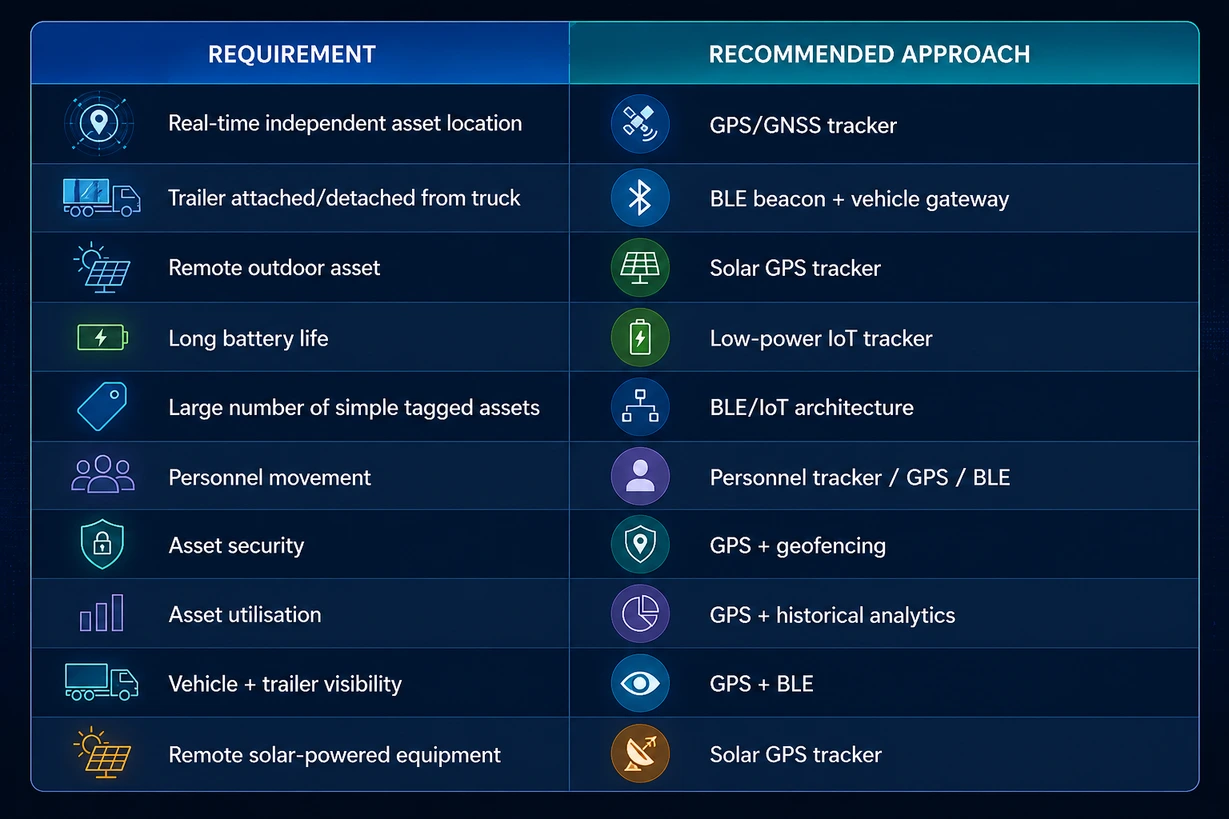
The best solution may actually combine several technologies.
The Future of Asset Tracking: From Tracking to Asset Intelligence
The future of asset tracking is not simply putting a GPS tracker on everything.
It is about creating asset intelligence.
Imagine a platform where the system can automatically determine:
Where is the asset?
Who is carrying it?
Which vehicle is it attached to?
How long has it been stationary?
Has it left an authorised location?
How often is it being used?
Has it experienced an impact?
Does it require attention?
This transforms asset tracking from a map-based application into an operational intelligence platform.
Frequently Asked Questions About Asset Tracking
What is asset tracking?
Asset tracking is the use of GPS, IoT, Bluetooth, sensors and software to monitor the location, movement, status and utilisation of physical assets.
What assets can be tracked?
Businesses can track trailers, ISO tankers, containers, construction equipment, machinery, solar assets, vehicles, mobile equipment and personnel, depending on the technology deployed.
Can trailers be tracked without installing a GPS tracker?
Yes. In some applications, a BLE beacon can be attached to the trailer while a compatible gateway on the prime mover detects the beacon. This can be used to determine attachment and detachment events.
How does Bluetooth asset tracking work?
A Bluetooth beacon is attached to an asset. A nearby gateway detects the beacon and communicates its identity to the tracking platform. When the beacon is no longer detected, the system can record a detachment or departure event, depending on the configuration.
Can an ISO tanker be tracked?
Yes. ISO tankers can be tracked using GPS/IoT trackers or identified using BLE beacons integrated with a vehicle tracking gateway.
How long does a solar asset tracker last?
Battery and operating life depend on the tracking interval, environment, solar exposure, battery configuration and other operating conditions. V3’s solar tracker supports multiple battery configurations and solar charging.
What is the difference between GPS and BLE asset tracking?
GPS is suitable for determining an asset’s geographical location independently. BLE is particularly useful for identifying nearby assets and relationships, such as whether a trailer or tanker is attached to a particular prime mover.
Can asset tracking help prevent theft?
Asset tracking can improve visibility and provide alerts for unexpected movement or geofence breaches. It can therefore contribute to theft prevention and recovery efforts, although tracking technology cannot guarantee that theft will not occur.
Can asset tracking be integrated with a Fleet Management System?
Yes. Integrating vehicle, asset and IoT information into one platform can provide fleet managers with a more complete view of their operations.
Is asset tracking only for large companies?
No. Asset tracking can be deployed at different scales. The appropriate technology depends on the number and type of assets, operational requirements and the value of the information generated.
Conclusion: Asset Tracking Is About More Than Knowing Where Things Are
Asset tracking has evolved significantly.
Businesses no longer have to choose between a basic GPS tracker and manual asset management.
Today, organisations can combine:
GPS + 4G + BLE + IoT + Solar + Sensors + Geofencing + Fleet Management Software
to create an integrated asset visibility ecosystem.
For a trailer fleet, this could mean knowing the location of every trailer.
For an ISO tanker operator, it could mean knowing which prime mover each tanker is attached to.
For a construction company, it could mean knowing where equipment is deployed.
For a solar asset operator, it could mean tracking remote assets without relying on fixed power.
For a facilities or emergency-response organisation, it could mean extending visibility to personnel.
The right question is therefore not:
“Which tracker should we buy?”
It is:
“What do we need to know about our assets, and what is the most efficient technology to provide that visibility?”
At V3 Smart Technologies, asset tracking can be designed around the operational requirement — from GPS and solar-powered asset tracking to BLE-enabled attachment and detachment monitoring, IoT sensors and personnel tracking.
The objective is simple:
Track. Connect. Optimise.
Turn your physical assets into connected assets — and your asset data into actionable operational insight.
Discover how to implement a Fleet Management System in your business here: 2026 Fleet Management System Guide: Features, Benefits & Costs in Malaysia.